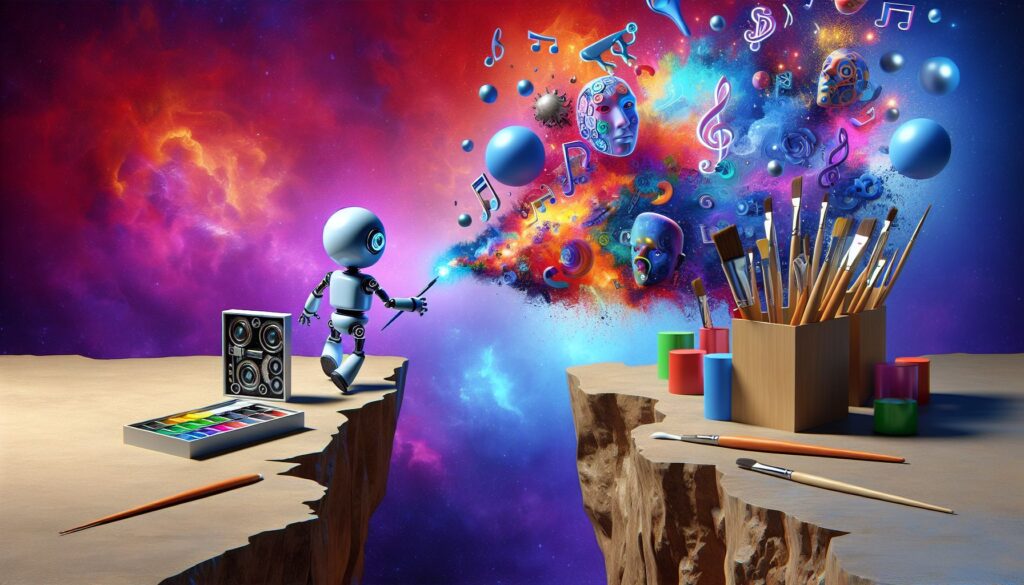
Greetings, fellow tech enthusiasts! Grab your futuristic goggles and art-critic hat because today we’re exploring the intersection of technology and creativity—a universe where artificial intelligence doesn’t just enhance but completely redefines what’s possible in the arts. Whether you’re an artist, techie, or just curious about where these developments are taking us, stick around. I’ve got some fascinating stories and insights to share.
The Dawn of Digital Da Vincis
Before we jump into the present marvels, let me share a little anecdote from my own journey with AI and art. A few years back, I stumbled upon a striking piece of digital artwork at a tech conference. It showed a complex cityscape, bustling with life and depth that rivaled some of the masterpieces hanging in art galleries. To my surprise, I found out that it was created by an AI, trained by a small startup. This encounter was a wake-up call, a realization that AI could do much more than analyze data and run factories—it could be creative.
Today, that initial insight has exploded into a full-blown revolution. From learning to replicate artistic styles to creating new, never-before-seen aesthetic expressions, AI is now a legitimate participant in the creative process. Imagine the audacity—a silicon-based artist working alongside our beloved human creators! Let’s poke around and see how this mix of bytes and brush strokes is developing.
AI Brushes and Guided Canvases
Style Transfer: The New Palette
One of the AI-driven art techniques that fascinates me is “style transfer.” If you’re not already familiar with it, style transfer is a method where an AI model separates the style of an artwork from its content. Using this method, AI can take a personal photograph you cherish and reimagine it in the style of Van Gogh’s swirling stars or Monet’s gentle brushwork. This isn’t just cool on a surface level—it’s a radical leap in our understanding of art and creativity. AI isn’t just copying styles. It’s learning them, absorbing knowledge through machine learning models and vast datasets.
When I tried it myself, I fed the AI a photo of my grumpy cat and styled it with Picasso’s flair. The result blew my mind and made me think: Is AI offering us a digital brush to paint our realities differently? The sky might not be the limit anymore. Maybe our own imaginations are.
Visual Storytelling: From Pixels to Plots
But wait, AI creativity doesn’t end with single-frame art. Enter AI-driven visual storytelling. Companies like OpenAI and DeepArt are making strides in creating coherent series of artworks that look visually appealing and tell compelling stories. With generative adversarial networks (GANs) and transformers, AIs are beginning to weave narratives with visual design, merging the boundaries between writer’s block and painter’s brush.
Democratizing Creativity: The Software Maestro
Here’s another tidbit that matters: AI has democratized access to sophisticated creative tools. Remember when you needed expensive software and a powerful PC to create digital art? Now, thanks to neural networks and cloud computing, many powerful tools offer automated art-making through apps or online platforms. These tools are opening doors to budding artists around the world who, once held back by technological or financial barriers, can now explore their creative vision through AI-assisted brushes.
AI and Music: Harmonizing Bytes and Beats
Moving from canvas to concert hall, AI is making waves in the music industry. AI-generated music started as a novel curiosity—remember the “BachBot” that made headlines by recreating classical compositions? Today, the likes of Google’s Magenta and AIVA (Artificial Intelligence Virtual Artist) aren’t just perfecting existing genres but are creating entirely new soundscapes.
Algorithms as Composers
AI is wading into unfamiliar musical waters. When I listened to a symphony co-created by AIVA, I found myself lost somewhere between human nostalgia and machine-generated novelty. It’s not about robots composing better than Mozart, not yet anyway, but rather algorithms helping new musicians explore compositions they might not dare to dream otherwise.
Music That Knows You
Let’s get a bit sci-fi here: imagine a world where AI creates personalized music scores that match your mood, activities, or even the rhythm of your life. We’re already seeing this with programs like Endel, using AI to generate ambient sounds designed to help you focus, relax, or sleep based on personal metrics.
Challenges: Beyond the Hype Train
With all these developments, we need to keep a level-headed perspective. AI artistry faces analytical and ethical challenges that we must grapple with as it grows:
Attribution and Authorship
Who gets credit when AI creates? Is it the tool, the programmer, or the art director? These aren’t trivial questions. The art community is wrestling with this, with implications for copyright and intellectual property laws. I had a laugh when someone at a conference quipped, “Should we be worried that one day, the AI might demand a share of the royalties?”
Artistic Authenticity
Another discussion making the rounds is about authenticity. Are AI-crafted artworks authentic expressions, or are they imitations? While some purists see AI creations as lacking soul, others argue they reveal new depths of creativity worth embracing.
Looking Ahead: AI’s Horizon in the Creative Arts
Peering into the not-so-distant future, I’m filled with optimism about AI’s role in creativity. With quantum computing and more advanced machine learning models on the horizon, what AI could achieve in creative arts will surely expand. As AIs become more capable, we may find ourselves collaborating with them rather than simply programming them.
Imagine films co-directed by AIs, stage sets created by algorithms, or architectural designs spun from digital minds far better at understanding complex geometry than any human. It’s an exciting time to be alive and witness this digital renaissance.
Don your creative hats and dive in headfirst! Whether you’re a techy or an artist, a critic or a daydreamer, explore these tools and revel in the unknown potential they promise. There’s a whole new world yet to be painted—and who knows, maybe your next masterpiece is just an algorithm away. Until next time, keep creating and stay curious!