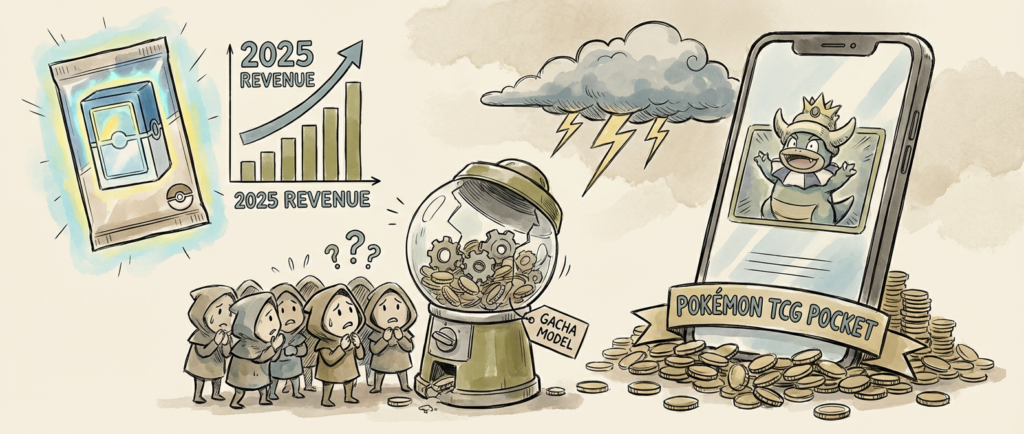
The Numbers That Broke the Internet (And Should Break Your Gacha Model)
Let’s start with the elephant in the room: Pokémon TCG Pocket hit over $200 million in revenue in its first two months. Two months. To put that in perspective, most gacha games spend their entire first year clawing toward that ceiling. According to Sensor Tower Mobile Gaming Revenue Reports, this isn’t just a win for The Pokémon Company. It’s a complete thesis statement about what players actually want from their mobile gaming experiences.

Here’s where it gets interesting for every other developer watching from the sidelines. This isn’t success because Pokémon TCG Pocket plays by the traditional gacha playbook. It’s successful because it fundamentally reimagined what gacha mechanics could be. The speed of adoption, the staying power, the conversion rates all tell a story that contradicts everything we thought we knew about mobile monetization.
By early 2026, the game had eclipsed 100 million downloads globally, making it the fastest-growing digital card game in mobile history according to data.ai. That’s not just market dominance. That’s a referendum on an entire category of game design.

The Wonder Pick Revolution: Why Communal Openings Changed Everything
The real genius move here isn’t the Pokémon IP. It’s the Wonder Pick mechanic, and if you’re a mobile developer who hasn’t spent serious time thinking about what it means, you’re already behind the curve. Instead of individual loot boxes that players pull alone, Wonder Pick creates communal pack openings where you’re literally deciding together with other players what cards appear in their packs. It’s psychological brilliance wrapped in social mechanics.
Regulatory bodies caught on immediately. Belgium and the Netherlands, the same jurisdictions that hammered other gacha games with loot box restrictions, took a markedly different approach to Wonder Pick. Why? Because the mechanic fundamentally changes how regulators classify the reward system. It’s not opaque randomness happening in isolation. It’s transparent, social, and observable. This distinction matters way more than most developers realize, and it’s only going to matter more over the next five years.
The game isn’t dodging regulation through clever legal language. It’s structurally different in a way that makes traditional loot box criticism less applicable. That’s not luck. That’s intentional design that anticipated regulatory pressure before it fully materialized.
Japan’s 2025 Gacha Guidelines: The Shoe That’s About to Drop Everywhere
In 2025, Japan’s Consumer Affairs Agency issued clarifications to their gacha guidelines that specifically addressed complete gacha-adjacent mechanics and multi-step reward systems. If you haven’t read Japan Consumer Affairs Agency Gacha Guidelines closely, you should. These aren’t theoretical restrictions. They’re actively reshaping how publishers structure progression systems right now.
What makes this particularly brutal for existing gacha developers is the timing and specificity. Japan doesn’t regulate in a vacuum. When they clarify guidelines around mechanics that games like Pokémon TCG Pocket don’t rely on, they’re essentially creating a roadmap for how other markets will regulate in 2026 and beyond. The games that already restructured themselves around these principles have a multi-year head start.
The practical implication? If your game uses traditional multi-step gacha mechanics where players need to pull multiple times to “complete” a set or unlock full functionality, you’re now operating in regulatory territory that’s getting visibly more hostile. Pokémon TCG Pocket’s structure sidesteps this entirely.
The Retention Proof Point Nobody’s Talking About Loudly Enough
DeNA, one of the largest mobile publishers in the world, reported in their Q3 2025 earnings that games featuring social reveal mechanics retained players 34% longer than equivalent single-player gacha titles in their own portfolio. Let that sink in for a moment. A 34% retention improvement. That’s not incremental. That’s transformational.
We’ve known for years that social features drive engagement. But there’s a difference between knowing something intellectually and seeing it measured at scale across multiple games. This data point proves that players don’t just enjoy social mechanics, they actively stay longer when gacha systems are built around them. For games struggling with month-two retention cliffs, that’s not a minor detail.
Wonder Pick isn’t just a flashy feature bolted onto a traditional gacha core, either. It’s so deeply woven into how the game functions that removing it would break the entire reward structure. Every mechanical decision reinforces the social layer. That’s why the retention numbers are so dramatic.
What This Actually Means for Your Favorite Game’s Future
If you’re playing a traditional gacha game right now, you’re watching a master class in how quickly player expectations can shift. Pokémon TCG Pocket has essentially reset what players think is acceptable in 2025 and beyond. They’ve experienced transparent, social, regulated-friendly gacha mechanics, and going back to isolated loot boxes is now a conscious choice to accept an inferior system.
For developers, the nervousness makes total sense. You can’t just bolt Wonder Pick onto an existing game. You have to rebuild your progression systems, your social infrastructure, your monetization philosophy from the ground up. That’s expensive. That’s risky. That’s why only developers with serious resources and serious conviction are making that move right now.
Here’s the part that should make you optimistic as a player who cares about game design: this moment is actually good for the medium long-term. Yes, some games will die. Yes, some publishers will double down on outdated mechanics until players abandon them. But Pokémon TCG Pocket proved that social, transparent gacha mechanics can generate massive revenue and retention, and that creates a permission structure for better designed games everywhere.
The old gacha model works. It’s profitable. But Pokémon TCG Pocket proved it’s not the only profitable path forward, and it might actually be the less profitable path now. That’s a genuinely interesting place for mobile gaming to find itself. What’s your take on how this shifts things for the games you’re playing?